
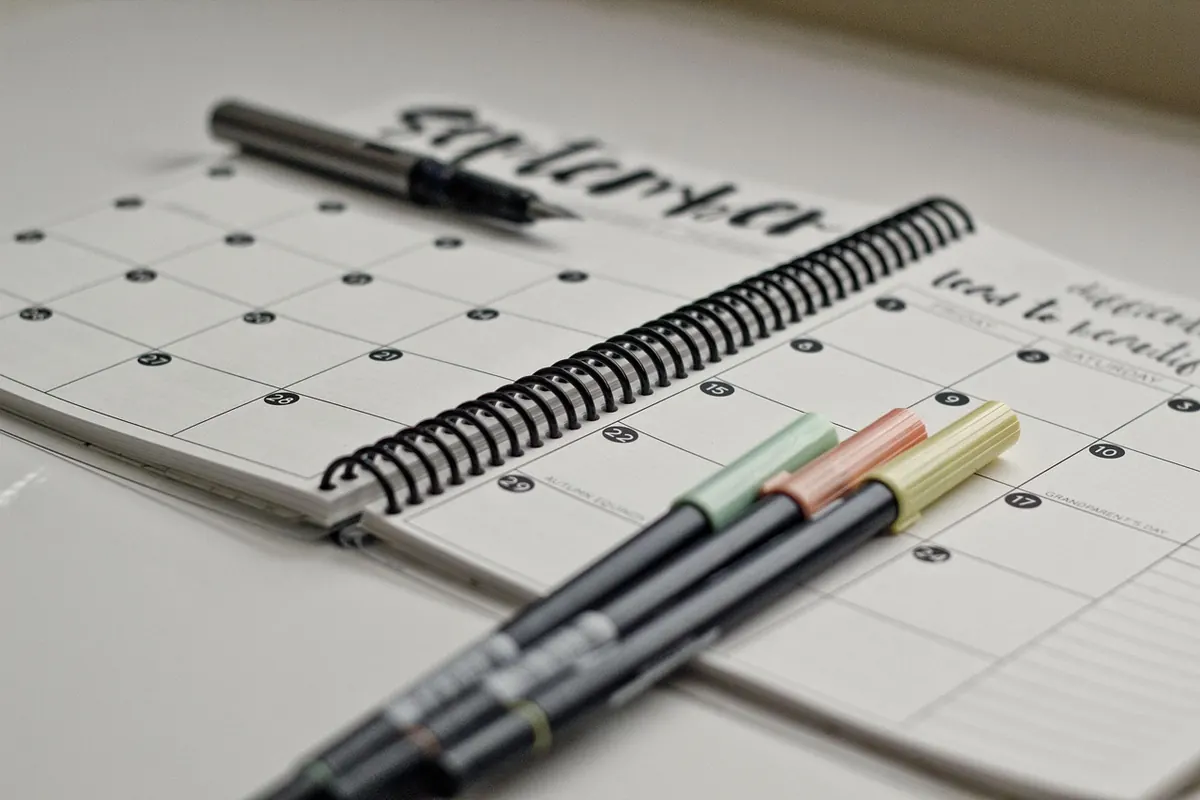


A 10-Point Monthly Journal Review Checklist for Personal Growth

A journal only earns its keep when you read it back. Writing daily captures the raw material; reviewing monthly turns it into something you can actually use. The difficulty is keeping the review simple enough that you will still do it on a wet Sunday afternoon when the ironing is calling. What follows is a ten-point routine that takes about an hour, needs nothing more than your notebook and a pen, and works whether you fill three lines a day or three pages.
Before You Begin: Pick a Date and Protect It
Choose a recurring slot and treat it as fixed. The last Sunday of the month suits many people; others prefer the first morning of the new month, when the previous one has properly closed. Either is fine, as long as it repeats.
Set up three things before you start reading. A clear hour with your phone face down. A fresh page headed with the month and the year. And a cup of something, because this is a sitting-down job, not a sprint. If you keep a running index at the back of your journal, that page will make the whole exercise twice as fast — one line per entry, noting the date and the main subject, is enough.
The 10-Point Monthly Review Checklist
Work through these in order. The first six are about reading; the last four are about deciding.
- Read the month in one sitting. Start at the first entry and read forwards without stopping. Do not edit, correct or judge. Notice only which passages you skim past — those often matter most.
- Mark the emotional weather. Go back and underline every word you used about how you felt. Flat, restless, steady, stretched. You are looking for the shape of the month, not an average.
- List what kept coming back. A project, a person, a worry about money, a bad night's sleep. Repetition in a journal is data, not failure. Three mentions in a month is a signal.
- Note who appears, and who has gone quiet. Names cluster in interesting ways. You will often find you write about certain people mainly when you are tired or anxious. That is worth knowing.
- Look at the gaps. The days you did not write, and the subject you circled for weeks without ever landing on it. Silence in a journal is information.
- Score last month's intentions. If you set three, give each one a plain yes, partly or no. Accuracy beats encouragement here. A kind no is more useful than a vague yes.
- Write down what worked. The walk before work. The early night. The conversation you had been putting off. Small and repeatable beats impressive and theoretical.
- Name the friction. What drained you, and which commitments you accepted reluctantly. Look for the pattern behind the individual yes — a person, a time of day, a type of request.
- Reduce the month to two sentences. What happened, and what it taught you. The brevity is the point; it forces you to decide what actually mattered.
- Set two or three intentions for next month. One that matters most, and two small enough to be almost certain. More than three and you are writing a wish list.
Reading for Patterns, Not Verdicts
An hour of honest reading can slide into an hour of self-criticism if you let it. The review is not a performance appraisal, and one difficult month proves nothing. Patterns show up over quarters, not weeks.
One mention of "exhausted" is a bad Tuesday. Four mentions, all in the same week, is a diary entry about your calendar.
This is where the summary page earns its place. Keep your two-sentence summaries together, either at the back of the journal or in a separate notebook, so you can read three months at once. A single month gives you a mood. Three months give you a direction. If you notice that the same worry has appeared in every summary since spring, it is no longer a passing thought — it is something to act on, or to talk through with someone you trust.
Turning Patterns into Intentions
An intention is not a resolution. It is a decision about where next month's attention goes, phrased so that you will know whether it happened.
Choose one keystone
Ask what would make the other problems smaller. If your entries are full of late nights, the keystone might be an earlier finish to the evening rather than a new exercise regime. One intention that removes friction is worth five that add effort.
Add two that are almost boring
Make them specific and countable. "Message one friend on Wednesdays" rather than "be more social". "Walk at lunchtime twice a week" rather than "get fitter". Boring intentions get done; inspiring ones get admired.
Write them on the first page of the new month, in the same place every time, so you meet them again on the first day back. And if a month goes badly and you miss the review entirely, do not skip it — combine two months into one longer sitting and carry on. The habit survives missed turns, not abandoned ones.
Three Traps That Undermine a Review
- Judging instead of noticing. The moment you start scoring your own character, you stop reading accurately. Describe what is on the page, then decide.
- Setting too many intentions. Ten good ideas scattered across a month achieve less than two that are quietly repeated. Keep the list short enough to remember without looking.
- Turning it into a project. Spreadsheets, colour-coded tabs, three new apps. The more elaborate the system, the sooner it is abandoned. A notebook and a pen will outlast most software.
Make It Stick
Put the next review in your diary now, before you close the notebook, and keep the ritual plain: same day, same hour, same page structure. The first one will feel slow. The third will take forty minutes. By the sixth, you will be reading a year of your own thinking and recognising the shape of it, which is the whole point.
One last thing worth saying plainly. If your entries keep returning to persistent low mood, heavy drinking, money worries or anything that frightens you, a journal is a good place to notice it but not the place to solve it. Speak to your GP or another qualified professional, and tell someone you trust. Writing it down is the beginning of the conversation, not the end of it.
Photo: Towfiqu barbhuiya / Pexels